An amusing contradiction sits at the center of modern luxury beauty. We are promised effortlessness through routines that require considerable effort, not to mention shelf space. I admire the ambition. I am less enthusiastic about the twenty-seven steps.
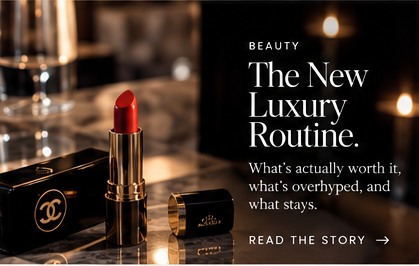
A beautiful object has always persuaded me to give it a chance. A lipstick in a heavy case, a cream that sits beautifully on a marble counter, a fragrance bottle with the confidence of a sculpture. Presentation matters. It is not the same as performance, but I see no reason we cannot appreciate both.
I like beautiful things. I also like things that work. Ideally, they are the same things, although the beauty industry occasionally seems determined to make us choose.
There is a particular pleasure in opening a well-designed product. The weight of the packaging, the satisfying click of a compact, the way a lipstick looks almost too elegant to use. These details may not improve the formula, but they certainly improve the experience.
And experience, whether anyone likes to admit it or not, is part of what luxury sells.
The Luxury of Knowing What Works
My favorite routines are edited, not elaborate. The point is not to own everything worth trying. It is to recognize the few things that deserve to stay.
Good skin, a precise lip color, hair that behaves just enough, and perhaps one indulgence that makes the whole process feel less like maintenance.
I have always preferred simplicity in how I dress, and I feel much the same about beauty. The goal isn't to look like I devoted an entire morning to my appearance, even when I may have spent a suspicious amount of time thinking about it. There is a difference between looking polished and looking overworked.
Celebrity beauty culture is particularly entertaining because it can make the most ordinary gestures look revelatory. Someone drinks water, sleeps eight hours, and announces a philosophy. A makeup artist uses twelve products to achieve a look described as “nothing.” We nod politely, then return to our own bathroom mirrors.
The celebrity beauty routine has become its own entertainment category. We watch actresses explain the products they use before an event, models demonstrate how they achieve supposedly effortless skin, and influencers present elaborate collections of creams, oils, serums, and devices as though maintaining a face were a small administrative department.
Some of these routines are fascinating. Others seem designed primarily to provide something interesting to film.
The team behind the result rarely makes it into the final edit. The facialist, dermatologist, makeup artist, hairstylist, lighting technician, and the person who knows exactly where to position the camera.
I have no objection to professional assistance—quite the opposite. I think we should acknowledge that a celebrity’s supposedly effortless appearance may take far more effort than the word suggests.
When Beauty Becomes Performance
There was a time when a beauty routine was largely private. You applied your makeup, did your hair, selected a fragrance, and left the house. The process belonged to you, with perhaps an occasional opinion from someone nearby.
Now the routine itself is content.
We watch people remove makeup, apply skincare, demonstrate facial massage, organize cosmetics, and explain why a particular product has changed their lives. The bathroom has become a studio, the vanity a set, and the ordinary act of getting ready a potential performance. I find the phenomenon endlessly interesting because it has changed what we expect beauty to look like.
We no longer want only the finished result. We want to see the work, as long as it remains attractive. We want expensive products arranged beautifully, an immaculate bathroom, matching towels, and the suggestion that a disciplined routine is the secret to a more successful existence.
Beauty has become lifestyle storytelling.
And naturally, the story is better when the marble is beautiful.
This is where luxury brands have become particularly skilled. They understand that a product does not exist only as a formula. It exists as an object, an image, an aspiration, and occasionally a rather expensive piece of bathroom decoration. A jar of cream can communicate taste before anyone has opened it.
Whether it deserves to remain on the shelf is another question.
The Problem With Having Everything
The beauty industry operates on the promise that something better is always arriving. A new formula. A new ingredient. A new technique. A new version of a product you already own and may not have finished. There is something wonderfully optimistic about this. Apparently perfection is always one purchase away.
I enjoy discovering products, but I have become increasingly interested in the difference between curiosity and accumulation. Trying something new because it genuinely interests you is one thing. Buying it because everyone else seems to have it is another.
The modern luxury consumer is constantly being invited to upgrade. A perfectly good moisturizer becomes insufficient because a more expensive one has appeared. A lipstick that looked beautiful last month suddenly seems less compelling because a new shade has been declared essential.
The result is a collection of products competing for attention, many of which perform nearly identical functions.
At some point, the routine stops feeling luxurious and begins to resemble inventory management.
I don’t particularly want to manage inventory in my bathroom.
A Better Kind of Excess
I have no objection to extravagance when it is genuinely pleasurable. I enjoy beautiful packaging, sophisticated fragrances, luxurious textures, and the occasional product that makes an ordinary Tuesday feel slightly more glamorous. But buying another serum just because it is everywhere isn't the same as developing taste.
Luxury becomes more interesting when you stop needing a new version of everything. Confidence comes from returning to the same lipstick, the same fragrance, or the same skincare product because it works for you. Repetition can become a signature. A familiar detail can be more distinctive than endless reinvention.
Fashion understands this particularly well. The most recognizable personal styles are rarely built on constant novelty. They are built on a consistent point of view.
Beauty should be no different.
I find a signature routine far more appealing than a complicated one. A few products chosen carefully. A little indulgence where it matters. Enough attention to look polished without turning the entire process into a production.
Naturally, if someone wants to provide flattering lighting, I am unlikely to object.
What Deserves to Stay
The longer I think about luxury, the less interested I become in having everything. There is something much more appealing about knowing exactly what you like.
A beautiful fragrance you return to for years. A lipstick that always looks right. A skincare product that earns its place because it performs rather than because someone famous has mentioned it.
These things become part of your personal vocabulary.
They are not necessarily the most expensive products in the room, nor are they always the newest. They are simply the ones that make sense for you.
I think that is where genuine luxury begins: not with unlimited choice, but with the ability to choose well.
What remains is a small collection of things that work, look beautiful, and feel like you. The rest is packaging. Sometimes very excellent packaging, admittedly.